AI Hair Studio
Try AI Simulator

The Science of Beauty: Decoding Your Facial Ratios (Three Courts & Five Eyes)

Have you ever wondered why certain hairstyles look stunning on celebrities but awkward on others? It’s not magic—it’s geometry. Let's dive deep into the specific metrics that define your unique face.

Beauty is often perceived as subjective, but aesthetically, it is deeply rooted in balance and proportion. Professionals in dermatology, plastic surgery, and hair styling rely on precise metrics—specifically the "Three Courts and Five Eyes" rule—to analyze facial harmony.

Too complicated to measure manually?

Let our AI scan your face and calculate these ratios instantly.

Start AI Face Analysis →

1. The Golden Ratio: Three Courts & Five Eyes
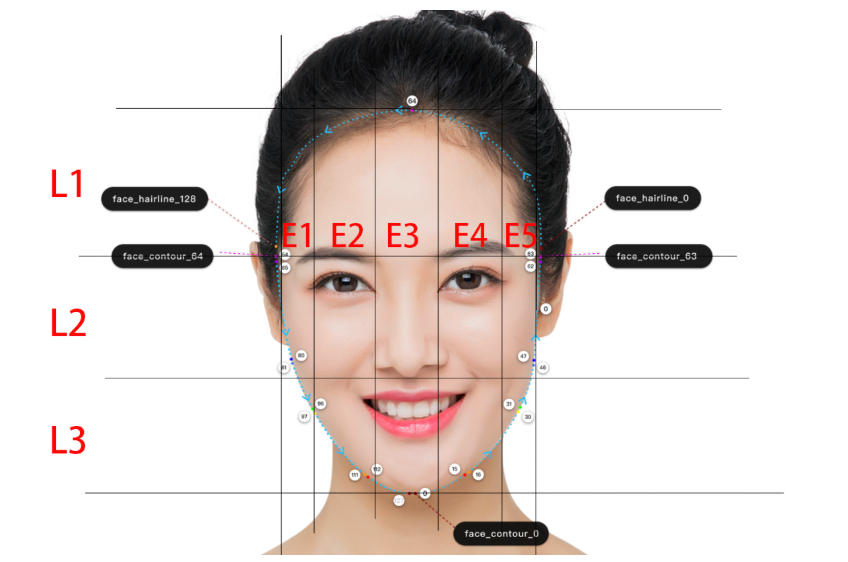
Three Courts and Five Eyes Diagram
Fig 1: Vertical (L1-L3) and Horizontal (E1-E5) measurements.

Vertical: Three Courts

  • Upper Court (L1): Vertical distance from the hairline (top contour) to the glabella (between eyebrows).
  • Middle Court (L2): Vertical distance from the glabella to the nasal tip.
  • Lower Court (L3): Vertical distance from the nasal tip to the lowest point of the chin.
Ratio Formula: l1:l2:l3, where l1=L1/C, l2=L2/C, l3=L3/C (C is total Face Length). Ideal ratio is 1:1:1.

Horizontal: Five Eyes

  • E1 (Right Temple): Right outer eye corner to facial contour.
  • E2 (Right Eye): Width of the right eye.
  • E3 (Intercanthal): Distance between inner eye corners.
  • E4 (Left Eye): Width of the left eye.
  • E5 (Left Temple): Left outer eye corner to facial contour.
Golden Ratio: E1:E2:E3:E4:E5 = 0.80 : 1 : 1.20 : 1 : 0.80 (with E2/E4 as base unit).
2. The Golden Triangle of Focus

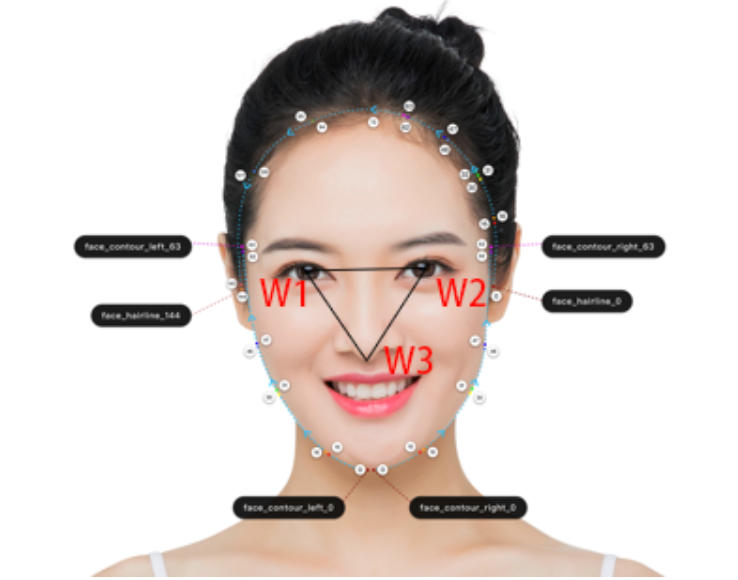
This triangle is the visual center of the face.

  • Triangle W1W2W3: Formed by the center of the left pupil (W1), right pupil (W2), and the nasal tip (W3).
  • Golden Angle (∠W1W3W2): The angle at the nose tip, ranging from [0, 180] degrees. This angle determines the perceived width of the midface.
Golden Triangle Diagram

3. Facial Contour: Defining Your Shape

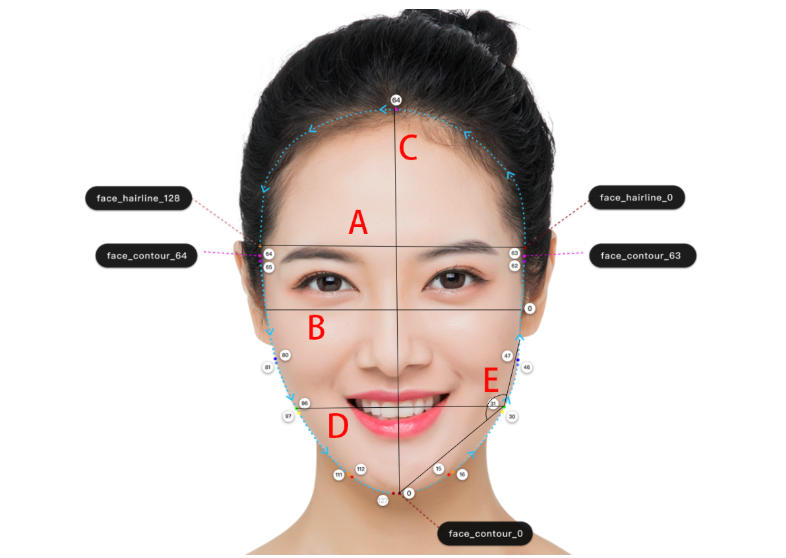
Facial Contour Diagram
A (Temporal Width):
Horizontal distance between temples.
B (Zygomatic Width):
Distance between the widest points of cheekbones.
C (Face Length):
From top of forehead (vertex) to bottom of chin.
D (Mandibular Width):
Distance between jaw angles.
∠E (Right Jaw Angle):
The angle of the right jawline, ranging from [90, 180] degrees.

4. The Details: Brows, Eyes, Nose & Lips

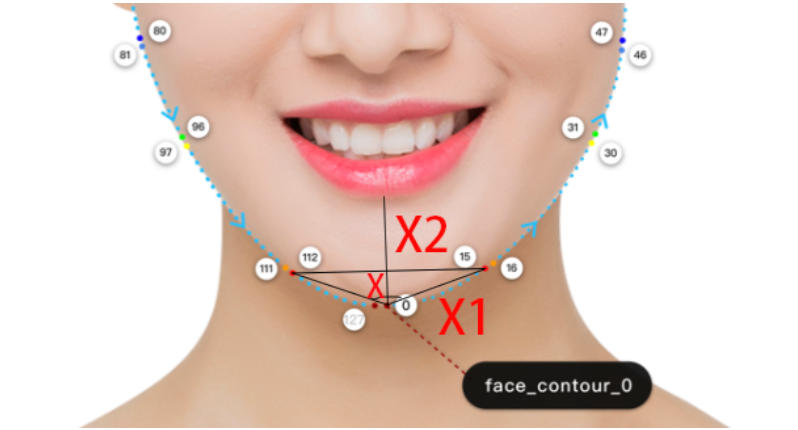
The Chin

  • X1 (Chin Width): Width of the chin area.
  • X2 (Chin Length): Vertical distance from lower lip bottom to chin bottom.
  • ∠X (Chin Angle): The angle forming the point of the chin.
Chin Measurement
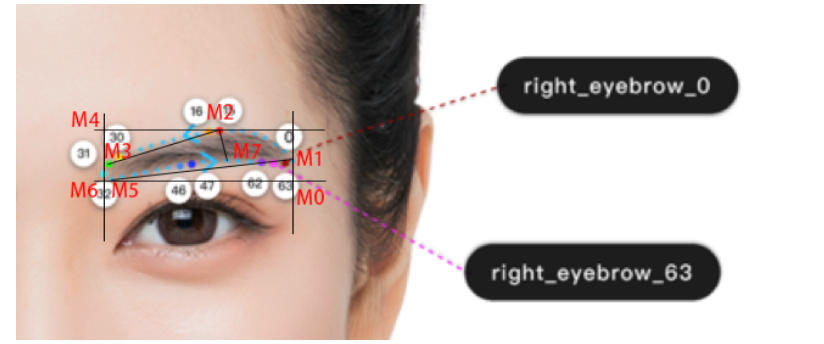
Eyebrow Measurement

The Eyebrows

  • M0M6 (Width): Distance from brow start to end.
  • M4M6 (Height): Vertical distance from peak to belly.
  • ∠M3M2M4 (Arch Angle): Angle between start and peak [-90, 90].
  • ∠M1M5M0 (Tilt): Angle of the brow line to horizontal [-90, 90].
  • M2M7 (Thickness): Distance from peak to glabella (brow center).

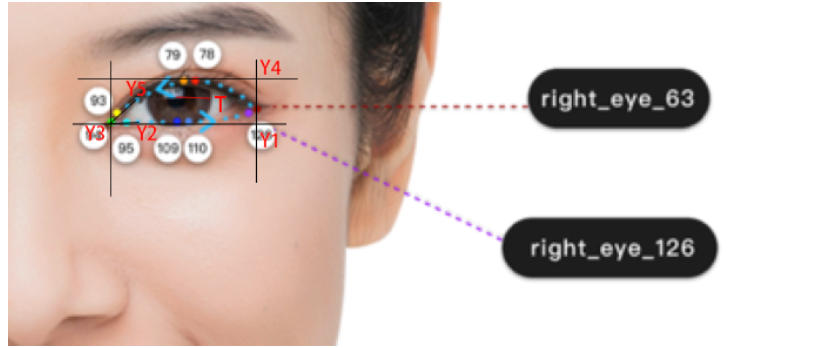
The Eyes

  • Y1Y3 (Eye Width): Inner to outer corner distance.
  • Y1Y4 (Eye Height): Upper eyelid to lower eyelid distance.
  • ∠Y2Y3Y5 (Inner Angle): The angle of the inner corner (canthus) [0, 180].
  • T (Pupil Radius): The size of the pupil.
Eye Measurement

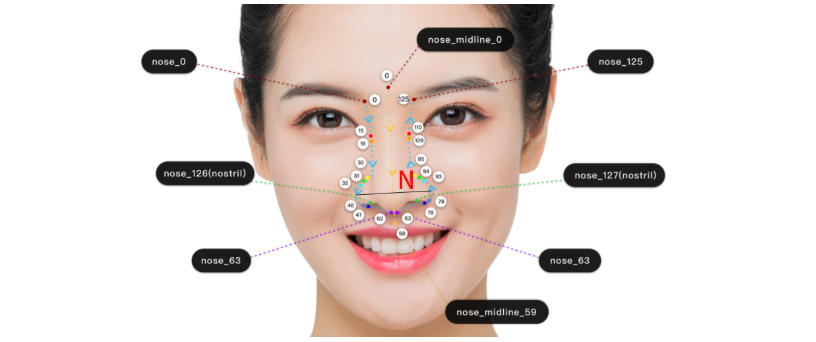
The Nose

N (Alar Width): Horizontal distance between nose wings.

Nose Analysis

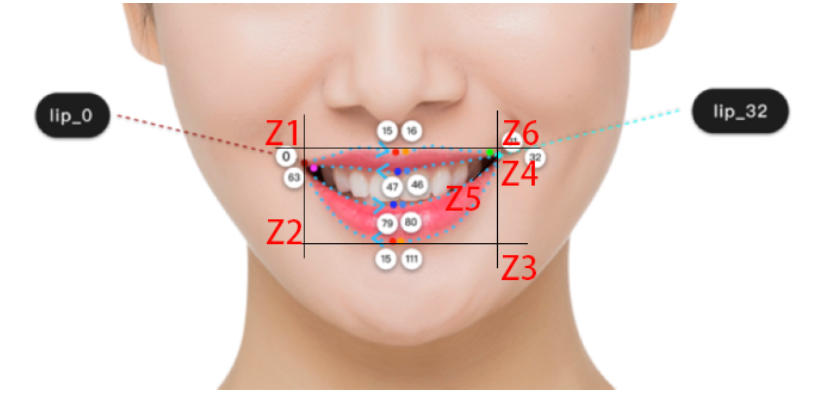
The Lips

  • Z1Z2 (Height): Upper peak to lower bottom.
  • Z2Z3 (Width): Corner to corner.
  • ∠Z5Z4Z6 (Curvature): Corner uplift angle [0, 180].
  • Thickness: (Upper + Lower) / 2.
Lips Analysis

Knowledge is Power, Styling is Magic

Understanding these metrics isn't about judging your face—it's about understanding your unique geometry. Once you know your measurements, you can choose hairstyles, glasses, and makeup that enhance your natural harmony.

Jack

Written by

Jack

Founder of AI Hair Studio. Passionate about combining AI technology with aesthetics to help people find their best look.