There is a geometry to beauty that often goes unspoken, a mathematical precision that defines the most striking faces in history. Among these, the diamond face shape stands apart as the rarest and most angular of all structures. It is the shape of modern allure, defined by dramatic cheekbones that catch the light and a jawline that tapers to a delicate point. If you have ever felt that your face was "too sharp" or "hard to style," consider this your reeducation. You possess the "High-Fashion Canvas"—a structure coveted by photographers and designers for its ability to hold light, shadow, and architectural style.
This guide is dedicated to the diamond-faced individual. Over the next 3000 words, we will dismantle the outdated advice that forces you to "soften" your features at every turn. Instead, we will explore how to balance your natural majesty with 2026's most exciting trends, from the heavy layers of the Butterfly Shag to the precision of the Bixie cut. We will decode your measurements, reveal the red flags of styling, and show you how AI technology can map your unique angles to your perfect haircut.
The Rare Radiance
In the pantheon of face shapes, the diamond is the elusive aristocrat. Statistically, it is one of the rarest configurations, occurring when the cheekbones are significantly wider than both the forehead and the jawline, which taper at the top and bottom. This "narrow-wide-narrow" structure creates a visual dynamism that is incredibly photogenic. Where oval faces offer smooth continuity and round faces offer softness, the diamond face offers drama. It is a shape built for high contrast, striking makeup, and architectural fashion.
Why is this shape so prized in high fashion? The answer lies in the cheekbones. High, prominent cheekbones are the pillars of the diamond face. In photography, they create natural hollows beneath, allowing for dramatic shadow play. Consider the visages that have defined modern beauty: Rihanna, with her piercing gaze and sculpted lower face; Megan Fox, whose angular symmetry has made her a pop-culture icon; and Scarlett Johansson, who balances soft features with a distinctly diamond-shaped jawline. These women do not hide their structure; they amplify it.
The diamond face is inherently editorial. It can support severe, slicked-back styles that would overwhelm a softer face, yet it also cradles romantic, face-framing waves with elegance. The "point" of the chin adds a femininity that balances the strength of the cheekbones. In 2026, fashion is moving away from the "Instagram Face" of homogenized fullness and back toward individual, structural beauty. The diamond face is at the forefront of this shift. It is no longer about "correcting" the wideness of the cheeks; it is about styling the hair to create a dialogue between the forehead, the cheekbones, and the jaw.
To understand the radiance of the diamond, think of it as a cut gem. A flat surface reflects little light, but a faceted one explodes with it. Your face shape is the gem; your hair is the setting. The setting should not hide the gem, but secure it and enhance its natural brilliance. This guide will teach you how to craft that setting using the tools of modern hairdressing and AI precision.
Decoding the Diamond
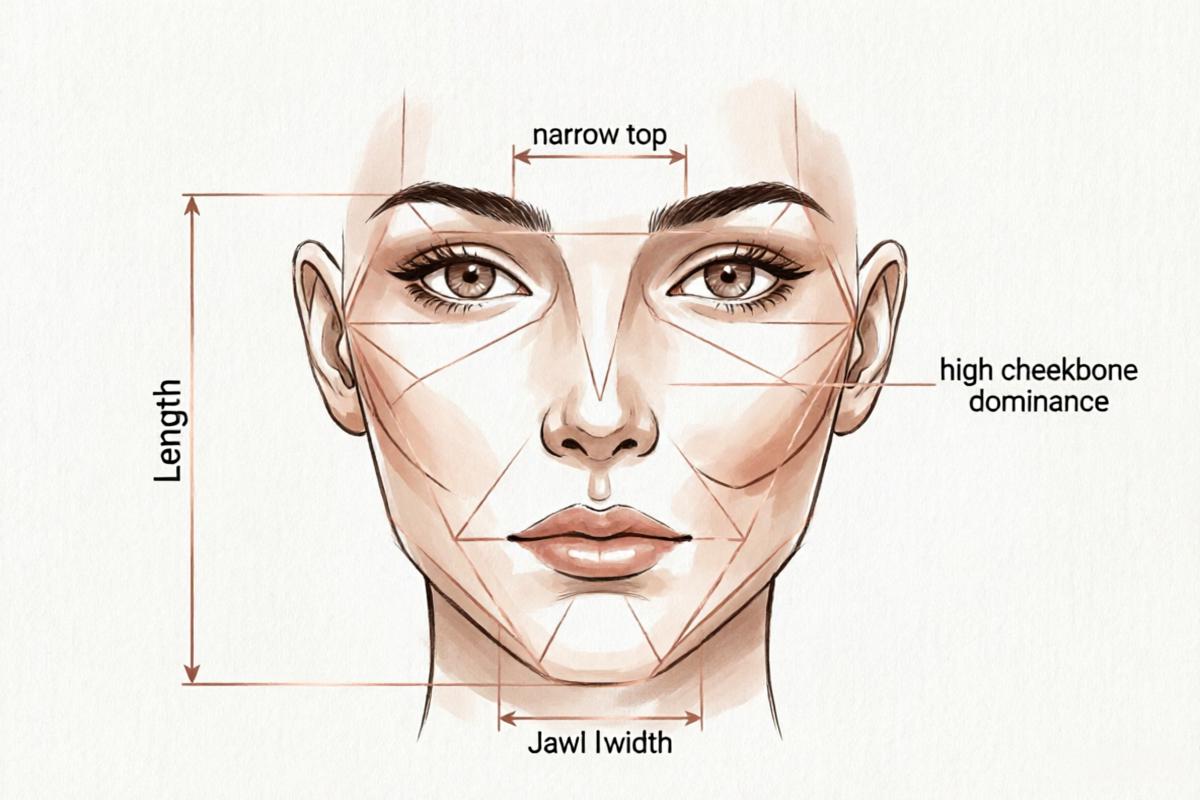
Before we can style, we must verify. Many people mistake diamond faces for oval or heart shapes, but the distinction is crucial. The diamond has a specific geometric signature: a narrow forehead, a dramatic widening at the cheekbones, and a tapering chin that comes to a softer or more angular point. Understanding these measurements empowers you to make informed decisions about cuts that might otherwise look unbalanced.
To accurately decode your face shape, you will need a flexible tape measure and a mirror, or simply a well-lit selfie. The key is to measure three specific points of width. First, measure across the widest part of your forehead, typically halfway between your brows and hairline. Second, measure across the top of your cheekbones, just below the outer corners of your eyes—this is usually the widest point on a diamond face. Third, measure your jawline at its widest point. Finally, measure the length of your face from the center of your hairline to the tip of your chin.
For a diamond classification, your cheekbone measurement will be significantly larger than both your forehead and jawline measurements. The forehead and jawline widths may be similar, but the forehead is the "narrow top" and the chin tapers down from the cheeks. The face length is typically longer than it is wide, but not as elongated as an oblong face. This "High Cheekbone Dominance" is your primary feature. It means that any style that adds width to the cheekbones (like a voluminous curl right at ear level) might make the face appear overly wide, while styles that add width to the forehead and chin (like a voluminous fringe or a bob that kicks out at the jaw) will create the coveted oval illusion.
2026 Trend: The 'Butterfly Shag'
If there is one haircut that seems genetically engineered for the diamond face, it is the 2026 iteration of the Butterfly Shag. This style, a cousin of the "Wolf Cut," is characterized by heavy, disconnected layers that flare out around the face like the wings of a butterfly. It is the ultimate solution for the diamond shape's unique challenge: how to soften the sharp transition from narrow forehead to wide cheekbone to narrow chin.
The magic of the Butterfly Shag lies in its layering architecture. The shortest layers typically begin around the nose or cheekbone level, but unlike traditional layers that blend downward, these layers are cut to "pop" out. This creates a feathered effect that hugs the cheekbones. For a diamond face, this is transformative. The volume of the hair at the sides of the face does not just sit there; it integrates with the cheekbones, softening their sharpness without hiding them. It essentially "fills in" the narrow areas of the forehead and jawline through strategic face-framing.
The Wolf Cut Evolution
The "Wolf Cut" has dominated the last few years, but 2026 brings a refinement: the "Soft Wolf." For diamond faces, the original Wolf Cut could sometimes be too aggressive, with too much volume concentrated exactly at the cheekbones. The 2026 evolution moves the "weight line" of the layers slightly lower, towards the jaw. This is a subtle but game-changing shift for the diamond shape. By moving the bulk of the layer from the cheek to the jaw, the cut adds volume to the narrow lower face, balancing the wide cheekbones and creating a seamless oval line.
Styling the Butterfly Shag for a diamond face requires a texture spray and a round brush. The goal is to encourage the "wings" of the hair to curve inward slightly at the forehead and outward at the jaw. This hourglass motion in the hair mimics the hourglass figure, creating harmony between the facial structure and the hair silhouette. It is a high-style, rock-n-roll aesthetic that feels thoroughly modern. It requires confidence, but on a diamond face, it looks remarkably natural, as if the hair was always meant to frame those angles.
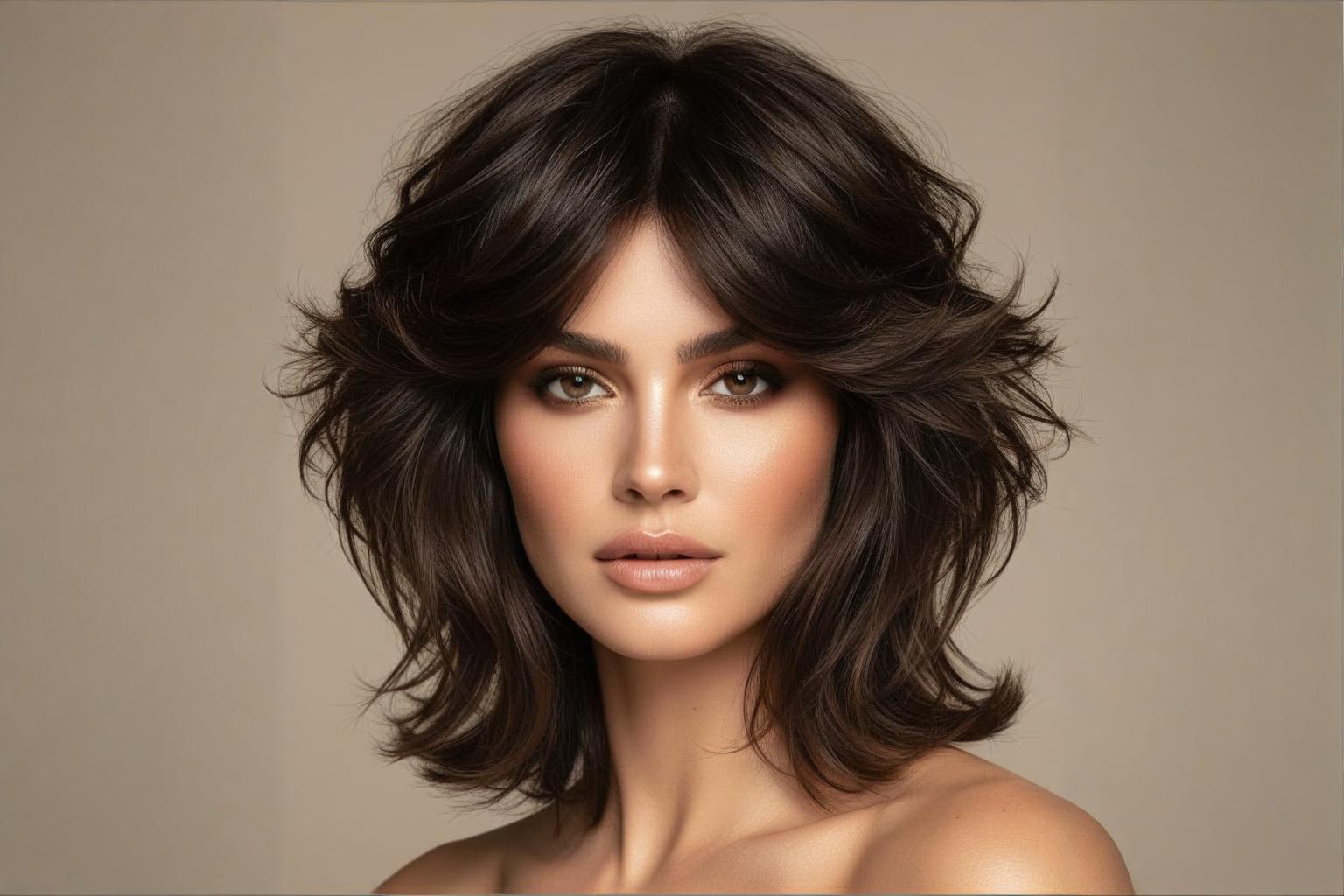
The heavy layers also serve to obscure the exact width of the cheekbones. Where a sleek style might "tell the truth" about the measurements, the shag tells a beautiful lie. It suggests a wider forehead and a stronger jaw, balancing the diamond into an oval through sheer volume and movement. It is the ultimate "cheat code" for angular features, providing softness through texture rather than length.
Short Hair Secrets: The 'Bixie' & Asymmetrical Bob
Short hair on a diamond face is a power move. It exposes the neck and draws attention to the eyes and lips, which are often the softer features of this shape. However, there is a fine line between chic and severe. The danger zone for diamond faces in short hair is creating a "pointed" look, where the narrow chin and forehead are emphasized, making the face look almost triangular. To avoid this, we turn to the "Bixie" (a blend of a bob and a pixie) and the Asymmetrical Bob.
The 'Bixie' Solution
The Bixie is the perfect compromise for the diamond face. It is short enough to be bold, but long enough to provide coverage. The ideal Bixie for this shape features tapered layers at the back (hugging the neck) but lengthens towards the front, hitting right at or below the jawline. This length is critical. Because the diamond face has a narrow jaw, the hair needs to end where the face widens or just below it, to visually "fill in" the narrow chin area.
Volume at the top and sides of a Bixie is essential. A flat, close-cropped pixie would make the cheekbones look stark and isolated. A textured, "tousled" Bixie with volume at the roots creates width at the forehead, balancing the cheekbones. This creates the illusion of a wider upper face, harmonizing the silhouette.
The Asymmetrical Bob
Symmetry is the enemy of the angular face. A perfectly even bob can highlight the sharp geometry of a diamond shape in an unflattering way. Enter the Asymmetrical Bob. By cutting one side slightly shorter than the other (even by an inch or two), you break the symmetry of the face. This diagonal line draws the eye across the face horizontally, rather than vertically down the narrow points.
The "Chin-Length Volume" rule is the golden rule for short hair on diamonds. Any style that ends right at the cheekbone level will emphasize the width. You want the style to end either above the cheekbones (a true pixie with volume) or, more safely, below them. A chin-length bob that curves under or kicks out adds the necessary bulk to the narrow lower face. It rounds out the point of the chin, giving the face a softer, more balanced finish.
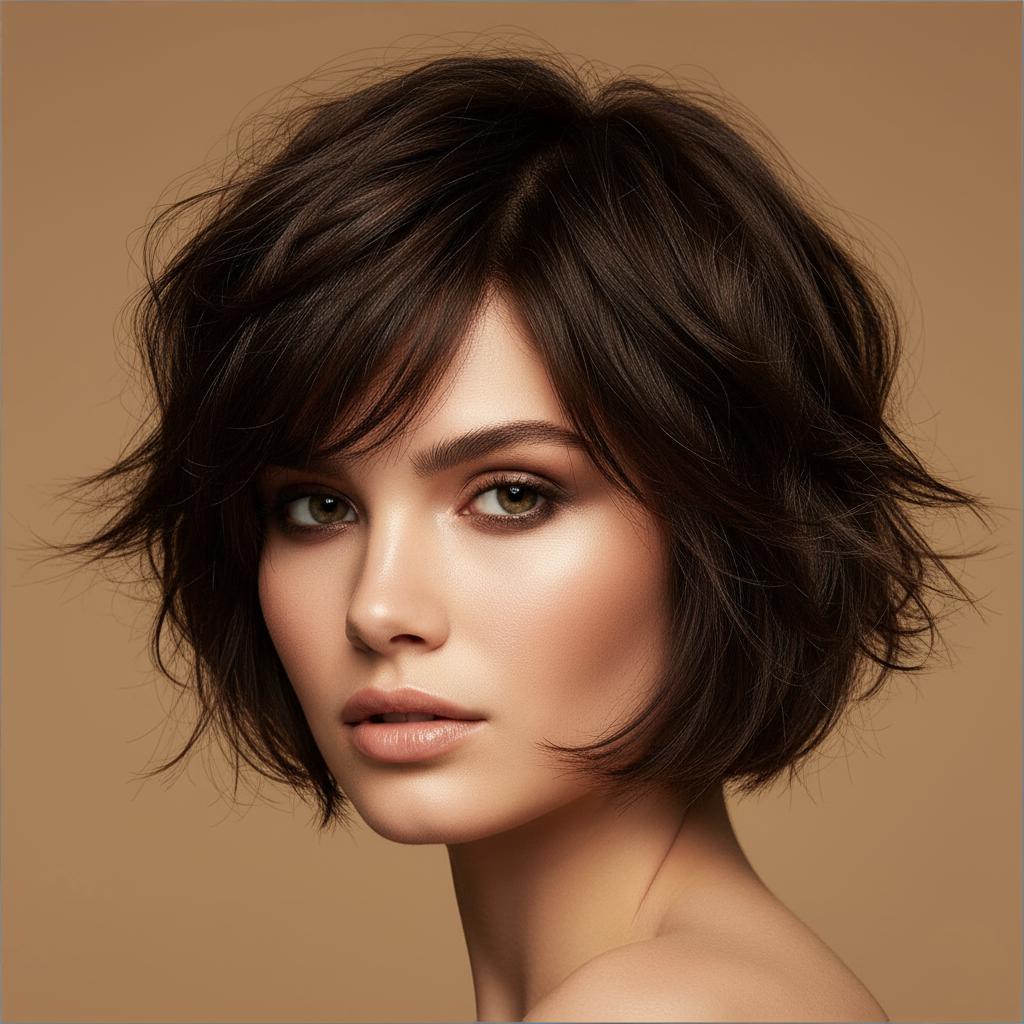
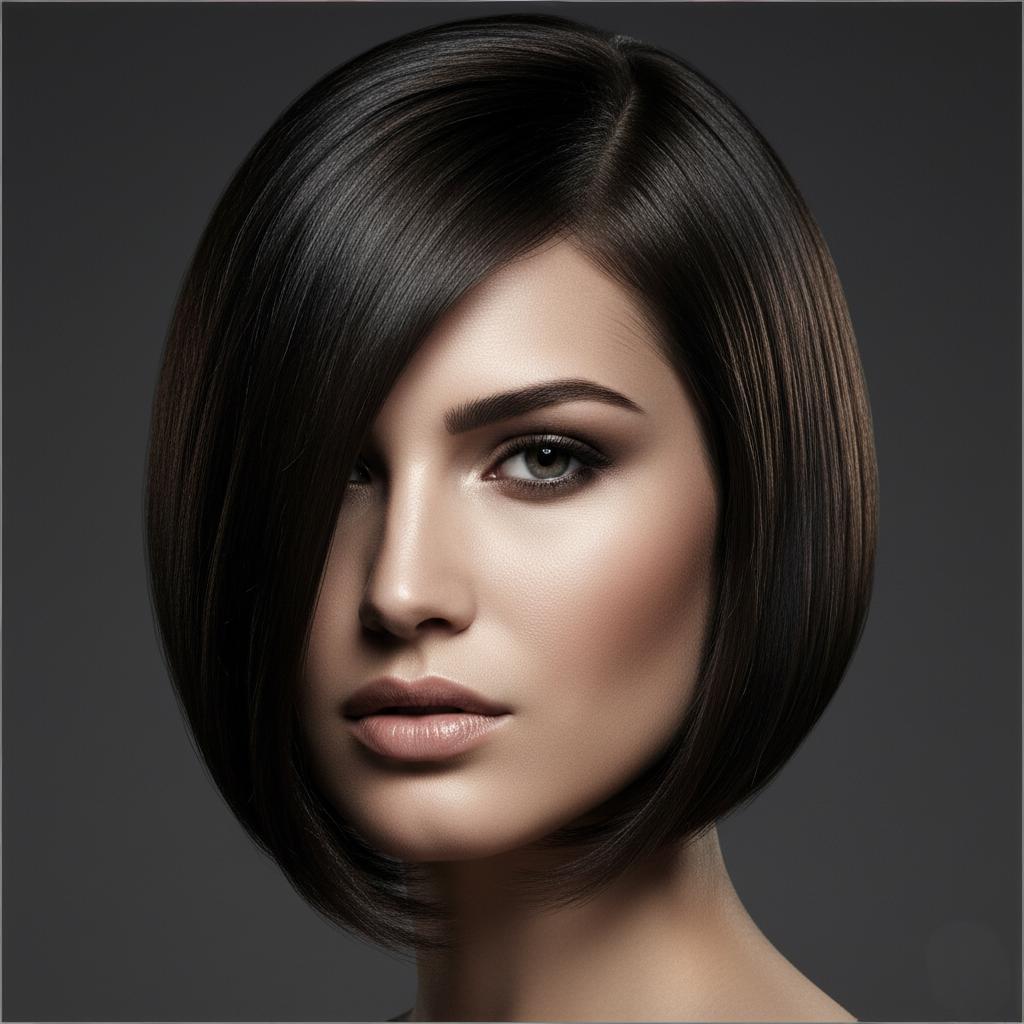
When consulting your stylist for a short cut, use the keyword "weight." You want weight at the sides, not the top. Weight at the top adds height, which diamonds don't need. Weight at the sides adds width, which diamonds need to balance the cheekbones. Ask for a cut that is "light at the crown and heavy at the perimeter."
Long Hair: Soft Glam & Interior Layers
Long hair on a diamond face is a canvas for "Soft Glam"—a 2026 aesthetic defined by polished, healthy waves that look effortless but are technically precise. The primary pitfall for long hair on this shape is the "Curtain of Hair" effect: long, flat layers that hang straight down on either side of the face. This frames the cheekbones like bookends, emphasizing their width and hiding the beautiful angles of the jaw and forehead. To avoid this, we must employ "Interior Layers."
The Strategy of Interior Layers
Interior layers are shorter layers hidden within the outer "curtain" of the hair. They are not face-framing; they are internal. Their job is to create lift and movement without removing length. For a diamond face, these layers should be focused around the jawline. When the internal hair has volume, it pushes the outer layers outward, creating a wide silhouette at the jaw. This expands the narrow lower face, balancing the dominant cheekbones.
Volume at the crown is generally discouraged for diamond faces, as it elongates the shape. Instead, the volume should start at the ears and extend downward. "Soft Glam" waves should begin at the jawline, not the crown. Using a large curling iron, start the curl at mid-shaft and wrap down. This leaves the roots flat (avoiding height) and creates a "bell" shape of volume that widens the lower third of the face.
"For diamond faces, the wave should start where the face narrows. We want to expand the silhouette at the jaw, not the cheekbone." — Session Stylist, Paris Fashion Week 2026
The "Middle Part Dilemma" often arises with long hair. A severe center part can draw a straight line down the middle of the face, highlighting the points of the diamond. A deep side part is universally more flattering, as it sweeps hair across the forehead, adding width to the narrow upper face. However, if you love a center part, ensure the hair at the roots has lift and the lengths have wave. A flat center part is the enemy; a voluminous one is merely a stylistic choice.

Bangs for Diamonds: 'Bottleneck' & 'Birkin' Bangs
Bangs are perhaps the most powerful tool in the diamond-faced arsenal. Because the diamond shape features a narrower forehead, the goal of bangs is to create the illusion of width at the top of the face. This "widening" effect brings the forehead into balance with the cheekbones, creating the coveted oval illusion. However, the wrong bangs can have the opposite effect, emphasizing the narrowness.
The Magic of 'Bottleneck' Bangs
"Bottleneck" bangs, also known as curtain bangs that split in the middle and taper down, are the gold standard for diamond faces. They work on the principle of the "V" shape. By parting in the center and feathering out towards the cheekbones, they create horizontal lines across the forehead. This visually stretches the narrow forehead, making it appear wider.
The length of these bangs is critical. They should hit just below the brow or at the cheekbone. If they end exactly at the widest point of the cheekbone, they can blend into the width, but if they are too short, they expose the temples. The "feathering" is key—blunt edges on a narrow forehead can look stark and unflattering (a "high-risk" move we will discuss). Soft, wispy edges allow the forehead to peek through, maintaining a sense of openness.
'Birkin' Bangs: The 2026 Revival
The "Birkin" bang, inspired by Jane Birkin, is a thicker, fuller, and slightly tousled fringe. For diamond faces, this is a superior choice to the "blunt brow bang." Why? Because the Birkin bang has "sides." It isn't just a block of hair across the forehead; it extends slightly onto the temples. This is the "magic trick." By extending the bang onto the temples, you artificially widen the forehead, creating a beautiful frame that balances the cheekbones. It is soft, romantic, and structurally perfect for the diamond shape.
The 'High-Risk' Blunt Bang
A straight-across, heavy, blunt bang is a "high-risk" move for diamond faces. It creates a horizontal line that can highlight the lack of width in the forehead if not styled correctly. If you desire a blunt look, ask for "textured ends" rather than a solid block to break the line and soften the transition.
The Diamond Face Styling Cheat Sheet
| Feature Challenge | Ear-Tucked Style | Volume Style (Recommended) |
|---|---|---|
| Narrow Forehead | Avoid slicking back tightly. Exposes narrow temples. | Use a side-swept fringe or loose waves at the crown to widen. |
| Wide Cheekbones | Tucking hair behind ears is risky; highlights bone width. | Face-framing layers or "Birkin" bangs that skim the cheeks. |
| Narrow/Pointed Chin | Can emphasize the "point" if hair is pulled up. | Chin-length bobs or waves that kick out at the jaw. |
Men's Style: The Textured Quiff & Tapered Sides
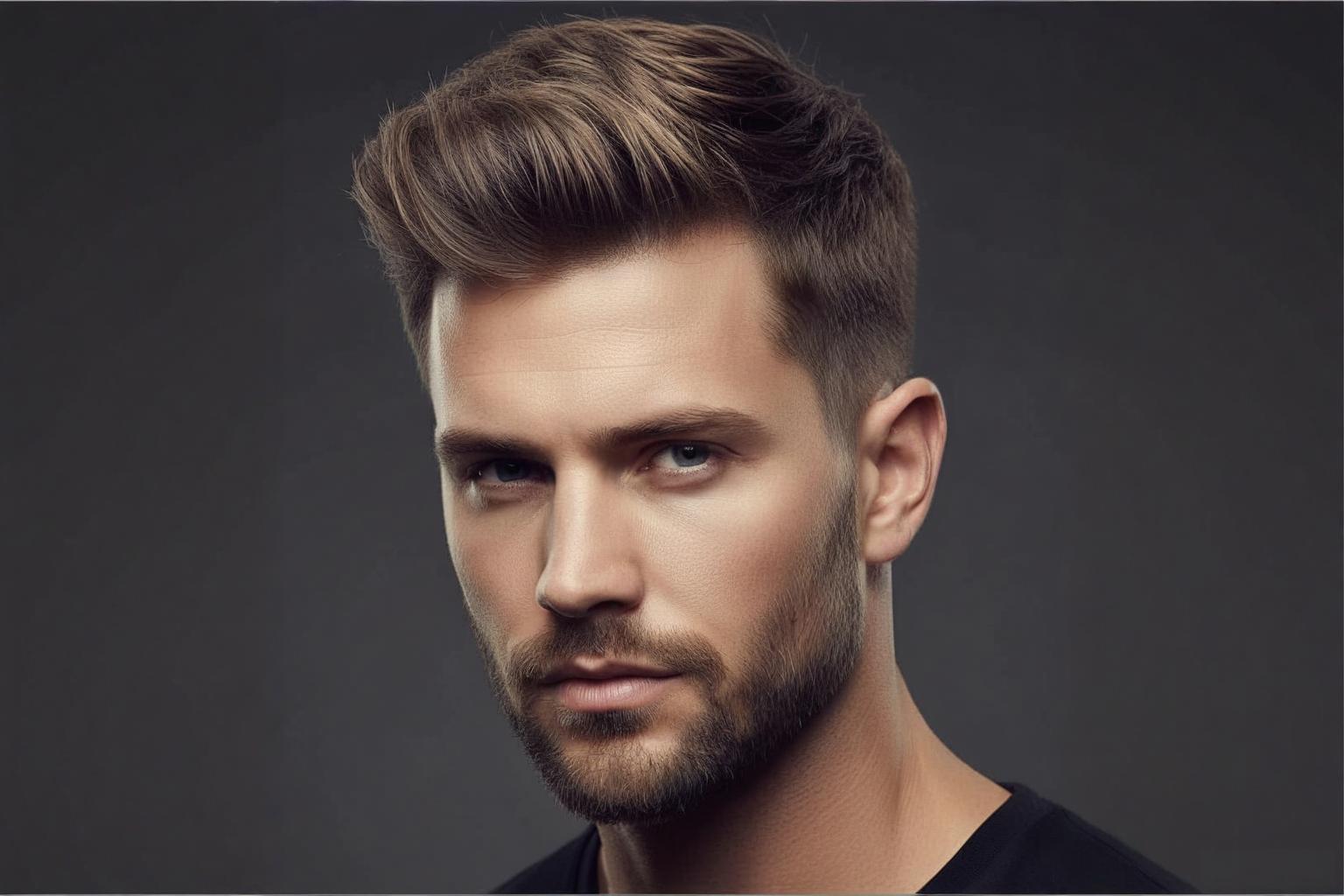
For men with diamond-shaped faces, the styling objective is identical to that of women: create width at the forehead and jaw, and minimize the focus on the wide cheekbones. The diamond face in men can give a striking, chiseled appearance, but without the right cut, it can look gaunt or overly sharp. The goal is to project strength without severity.
The Textured Quiff
The classic Quiff, when textured rather than slicked, is an excellent choice for the diamond face. The key is "texture" over "slick." A slicked-back quiff can flatten the sides and expose the cheekbones, creating a "winged" look at the ears. A textured quiff, styled with a matte paste or sea salt spray, adds volume at the forehead (widening the narrow top) while keeping some length on the sides.
Avoid the "Skin Fade" mistake. While fades are trendy, a high skin fade that cuts the sides too short will remove all width from the temple area, making the cheekbones pop out aggressively. Instead, opt for "Tapered Sides" that leave a finger's width of hair above the ears. This softens the transition from the cheekbone to the ear and creates a square, masculine silhouette.
Creating Width at the Temples
If you have a diamond face, you want to avoid cuts that are "tight" at the sides. Even if you prefer short hair, ask your barber for a "scissor cut" on the sides or a low guard that leaves some density. Growing in sideburns can also help; they add weight to the side of the face, visually widening the jawline and breaking the sharp line of the cheekbone.
The 'Red Flag' Styles
While the diamond face is versatile, there are specific styles that serve as "red flags." These are cuts or styling choices that work against the geometry, emphasizing the narrow points and the wide cheekbones in unflattering ways. Avoiding these pitfalls is just as important as knowing what works.
The Sleek High Ponytail
This style pulls the hair tightly away from the face, exposing the narrow forehead and leaving the cheekbones as the dominant feature. It can look severe and "gaunt." If you love an updo, leave face-framing tendrils or opt for a low, loose chignon.
The Extreme Center Part
A straight center part with flat hair draws a vertical line down the center of the face, emphasizing the points of the diamond. It can make the face look elongated and sharp. Always opt for movement or a side part to break the verticality.
Volume at the Cheekbones Only
A style where the only volume is concentrated exactly at ear-level will exaggerate the width of the face. Volume should be distributed, either higher (at the forehead) or lower (at the jaw), to create balance.
Red Carpet Occasion Styling
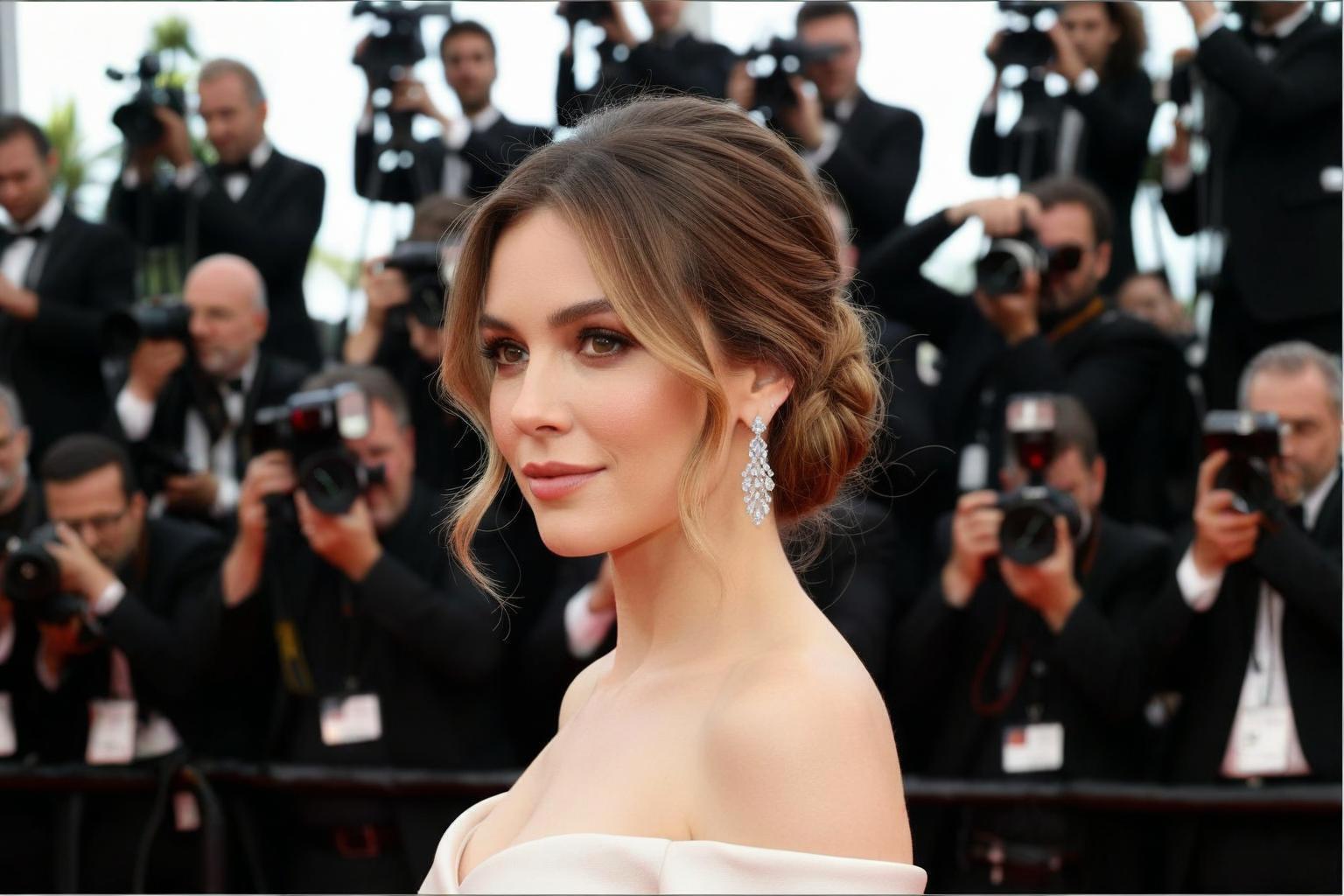
For special occasions, the diamond face can carry off some of the most glamorous styles in the book. The key to red carpet hair for this shape is "breaking the angularity" with softness. Updos should not be severe; they should be romantic, featuring "tendrils" and texture that soften the hard lines of the face.
Soft Updos with Tendrils
A tight ballet bun is rarely the best choice for a diamond face, as it pulls the hair away from the temples, exposing the narrow forehead. Instead, consider a low, textured chignon or a "Hollywood" updo. The defining feature should be "tendrils"—small, soft pieces of hair pulled out around the temples and jawline. These tendrils cast shadows and add visual width to the narrow parts of the face, creating a romantic frame.
Half-up styles are also highly effective. By pulling the top half of the hair back but leaving the bottom half down, you create volume at the crown (widening the forehead) while the loose hair around the shoulders fills in the jawline area. It is a style that mimics the "long layer" effect but with the formality of an updo.
Accessories are a diamond face's best friend. A headband placed across the forehead (boho style) can artificially widen the forehead, while large earrings draw the eye to the jawline and neck. Use these tools to direct attention to your chosen focal points.
AI Hair Studio: The Precision of Neural Mapping
Styling a diamond face requires precision. A centimeter of layer placement can be the difference between a style that balances and one that exaggerates. This is where the limitations of traditional styling—and the revolutionary power of AI—diverge. AI Hair Studio (https://www.aihair.studio) introduces "Neural Mapping," a technology that addresses the unique needs of angular faces with unprecedented accuracy.
Detecting Cheekbone Peaks
The core challenge for diamond faces is the cheekbone. The AI doesn't just "see" a face; it maps coordinates. When you upload a photo, the neural network identifies the "peaks" of your cheekbones and measures the gradient between your forehead, cheeks, and jaw. It calculates the exact width ratios discussed in Chapter Two.
This data allows the AI to suggest styles that mathematically create an oval illusion. It knows that if your forehead is X inches wide and your cheekbones are Y inches wide, you need a bangs style that extends Z inches onto the temples to create balance. It takes the guesswork out of "widening" and "softening."
For the user, this means the end of bringing a celebrity photo to the salon only to hear, "Her face is different from yours." The AI renders the style on *your* face, with your unique peaks and valleys. You can see if a "Bottleneck Bang" truly works on your narrow forehead, or if a "Butterfly Shag" is too much volume for your specific cheekbone structure. It is a tool of empowerment for the angular and the rare.